

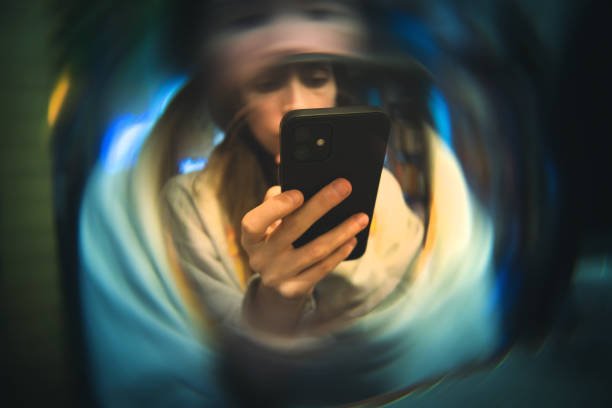
It's the modern bedtime story: you climb into bed, tell yourself you'll check your phone for five minutes, and surface forty-five minutes later — more awake than when you started. Then you lie there wondering why sleep won't come. If that's a nightly ritual, your screen habits may be working against your sleep in two distinct ways: one involving light, and one involving your mind.
Your Brain's Ancient Light Meter
Deep in your brain sits a master clock that keeps your body on a roughly 24-hour rhythm — the circadian rhythm. Its most powerful timekeeping cue is light. For most of human history, that system worked flawlessly: bright light meant daytime and alertness; darkness triggered the release of melatonin, the hormone that tells your body night has arrived.
Screens complicate this elegant system. Phones, tablets, laptops, and TVs emit a meaningful amount of blue-wavelength light — the same wavelength most abundant in morning sky light. When your eyes take in that light at 11 p.m., your brain receives a message evolution never prepared it for: it's morning. Research consistently links evening light exposure with suppressed melatonin, delayed sleepiness, and a body clock that drifts later and later.
The result: you feel wired at bedtime, fall asleep later than intended, and wake feeling like your night got cut short — because, biologically, it did.
It's Not Just the Light — It's the Content
Blue light gets the headlines, but what's on the screen may matter just as much:
- Doomscrolling and news feeds activate stress and vigilance — the exact opposite of the wind-down your nervous system needs.
- Social media invites comparison, rumination, and "one more scroll" design loops engineered to keep you engaged.
- Work email in bed teaches your brain that the bedroom is an extension of the office.
- Cliffhangers and autoplay are built to override your intention to stop.
Sleep requires your brain to downshift. Screens are downshift-proof by design. So even with a perfect blue-light filter, an argument on social media or a stressful email will keep your mind revving long after the phone is down.
There's also a stealthier cost called bedtime procrastination — putting off sleep, night after night, for low-value scrolling you don't even particularly enjoy. It's especially common in people whose days feel overloaded, because late night feels like the only time that belongs to them. The freedom is real; unfortunately, so is the exhaustion.
Reclaiming Your Nights Without Going Off-Grid
You don't have to banish technology to sleep well. A few high-leverage changes:
- Set a screen sunset. Aim to end screen use thirty to sixty minutes before bed. If that feels impossible, start with fifteen minutes and grow it.
- Dim your world in the evening. Lower household lights after dinner and use night-mode/warm settings on devices. Bright overhead light works against melatonin too, not just screens.
- Charge your phone outside the bedroom — or at minimum across the room. An old-fashioned alarm clock removes the main excuse.
- Replace, don't just remove. The scroll fills a void. Give the wind-down window a job: paper book, shower, stretching, journaling, quiet music, or time with your partner.
- Move stressful content earlier. If you must check news or email, do it hours before bed, not minutes.
- Get bright light in the morning. Sunlight soon after waking anchors your body clock — one advantage of living in the Las Vegas Valley, where sunshine is rarely in short supply.
Expect the first few nights to feel twitchy. The pull toward the phone is a habit loop, and habit loops protest before they fade.
When Screens Aren't the Whole Story
Sometimes late-night scrolling isn't the cause of sleeplessness — it's the coping strategy for it. Many people reach for their phones because lying in the dark alone with their thoughts feels unbearable: worries surge, the mind races, and the screen offers escape. If you remove the phone and find anxiety, racing thoughts, or low mood waiting underneath, that's worth taking seriously. Persistent insomnia and nighttime anxiety are treatable, and a professional evaluation can identify what's actually keeping you awake rather than leaving you to guess.
How Brighter Tomorrow Can Help
If sleepless nights have become the norm — whether screens started it or something deeper is keeping you awake — our therapists in Las Vegas can help you get to the root and rebuild restful nights. We offer in-person care and telehealth across Nevada. Get scheduled today