

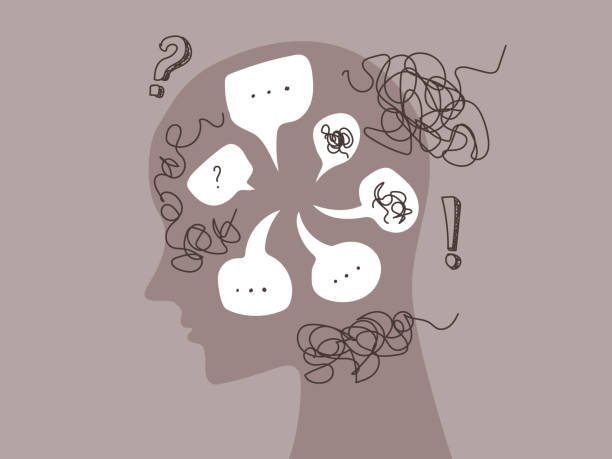
An audiologist tells you your hearing is essentially fine and there is nothing to be done. You go home to a quiet house and the sound is still there, and now you understand that it may always be there, and something in your chest tightens.
That moment — not the sound itself — is where tinnitus distress usually begins.
The counterintuitive finding
A great deal of research has looked for a relationship between the measured loudness or pitch of tinnitus and how much a person suffers from it.
There is barely any relationship at all.
People with quiet tinnitus can be severely disabled by it. People with loud tinnitus can be entirely unbothered. What predicts distress is not the acoustic signal but the brain's response to it — specifically, whether it has been classified as a threat.
This is genuinely good news, because the sound is often difficult to change and the response is very much modifiable.
How the loop forms
1. You notice it. Often after a loud event, an ear infection, stress, or simply a quiet night.
2. You interpret it as threatening. Something is wrong with my brain. This will get worse. I will never sleep again. I will not be able to work.
3. Your threat system activates. The limbic system flags the sound as important. Attention gets automatically directed toward it.
4. You monitor it. Checking whether it is there, whether it is louder, whether it has changed.
5. Monitoring amplifies it. Attention to any sensory signal increases its perceived intensity. This is why you notice a clock ticking once you have thought about it.
6. Distress increases, which strengthens the threat classification, which increases monitoring.
The sound has not changed. The system's relationship to it has.
The habituation the brain already knows how to do
Your brain filters out an enormous amount of constant sensory input — the feeling of your clothes, the hum of a refrigerator, traffic noise outside. These signals are processed and then classified as unimportant, and awareness of them fades.
Tinnitus can go through the same process. It usually does not when the sound has been flagged as dangerous, because the brain does not habituate to threats. That is exactly what it is designed not to do.
So treatment aims at reclassification rather than elimination.
What works
Cognitive behavioral therapy for tinnitus has the strongest evidence of any intervention for tinnitus distress. Note carefully what it improves: not the sound, but the distress, the interference with daily life, and the associated anxiety and depression. That is what people actually want.
Components include:
Education. Understanding the mechanism reduces the threat interpretation immediately for many people. A large part of the fear comes from imagining causes that are not the case.
Attention retraining. Learning to deliberately shift attention outward rather than monitoring the sound.
Cognitive work. Targeting the catastrophic predictions — that it will get unbearable, that you will never sleep, that your life is over.
Reducing safety behaviors. Constant checking, avoiding silence, avoiding social situations. These maintain the problem.
Sleep work. Insomnia and tinnitus reinforce each other powerfully, and behavioral sleep treatment is often the single highest-value component.
Relaxation. Not to eliminate the sound, but to lower the physiological arousal that amplifies it.
Sound therapy. Low-level background sound reduces the contrast between the tinnitus and silence, making habituation easier. A fan, a white noise machine, or an app is enough for many people; hearing aids with sound generators are used where hearing loss is also present.
Hearing aids. Where hearing loss is present, treating it frequently improves tinnitus substantially. Worth pursuing before assuming nothing can be done.
What makes it worse
Endless searching for a cure. Understandable, and it keeps the condition centrally in your attention. It is also the primary market for expensive supplements with no evidence behind them.
Silence. Complete quiet maximizes the contrast and is the hardest environment.
Constant volume checking. Direct amplification of the loop.
"Just ignore it." Correct in principle, useless as instruction — like being told not to think of something.
Waiting for it to go away before living. Life postponed until the sound stops is life postponed indefinitely, and the withdrawal itself deepens the distress.
When to get medical evaluation
See a physician or audiologist promptly for: tinnitus in one ear only; pulsatile tinnitus that beats with your heart; sudden onset with hearing loss; associated dizziness or vertigo; or tinnitus following a head injury.
Those warrant investigation. Most tinnitus does not indicate a dangerous underlying condition, but these presentations should be checked.
Noise exposure in a city built on it
Noise exposure is an occupational reality for a large number of people here — casino floor staff, nightclub and concert workers, musicians, aviation ground crew, and construction. Tinnitus is significantly more common in these populations, and hearing protection is frequently inconsistent.
If you work in a high-noise environment, protecting the hearing you have is the most important preventive step available, and it is not too late even if tinnitus is already present.
When it has led somewhere darker
Severe tinnitus distress is associated with elevated rates of depression and anxiety, and in a minority of cases with suicidal thinking. This is not a minor complaint and it deserves proper care.
If you are having thoughts of ending your life, 988 is answered any hour by call or text.
Getting help here
We work with adults on anxiety, health-related anxiety, insomnia, and cognitive behavioral approaches to distress about physical symptoms. Sessions are available at our east valley office on E Russell Road, our northwest office on N Durango Drive, and by secure video anywhere in Nevada. We are in network with most major insurance plans.
Audiological evaluation should come from an audiologist; the psychological work happens alongside it and is where most of the improvement in quality of life comes from.
The goal is not silence
Most people who do well with tinnitus still hear it if they listen for it. What changed is that they stopped listening for it, stopped fearing it, and stopped arranging their life around it.
That is an achievable outcome and it is what treatment is aimed at. Book a session.