

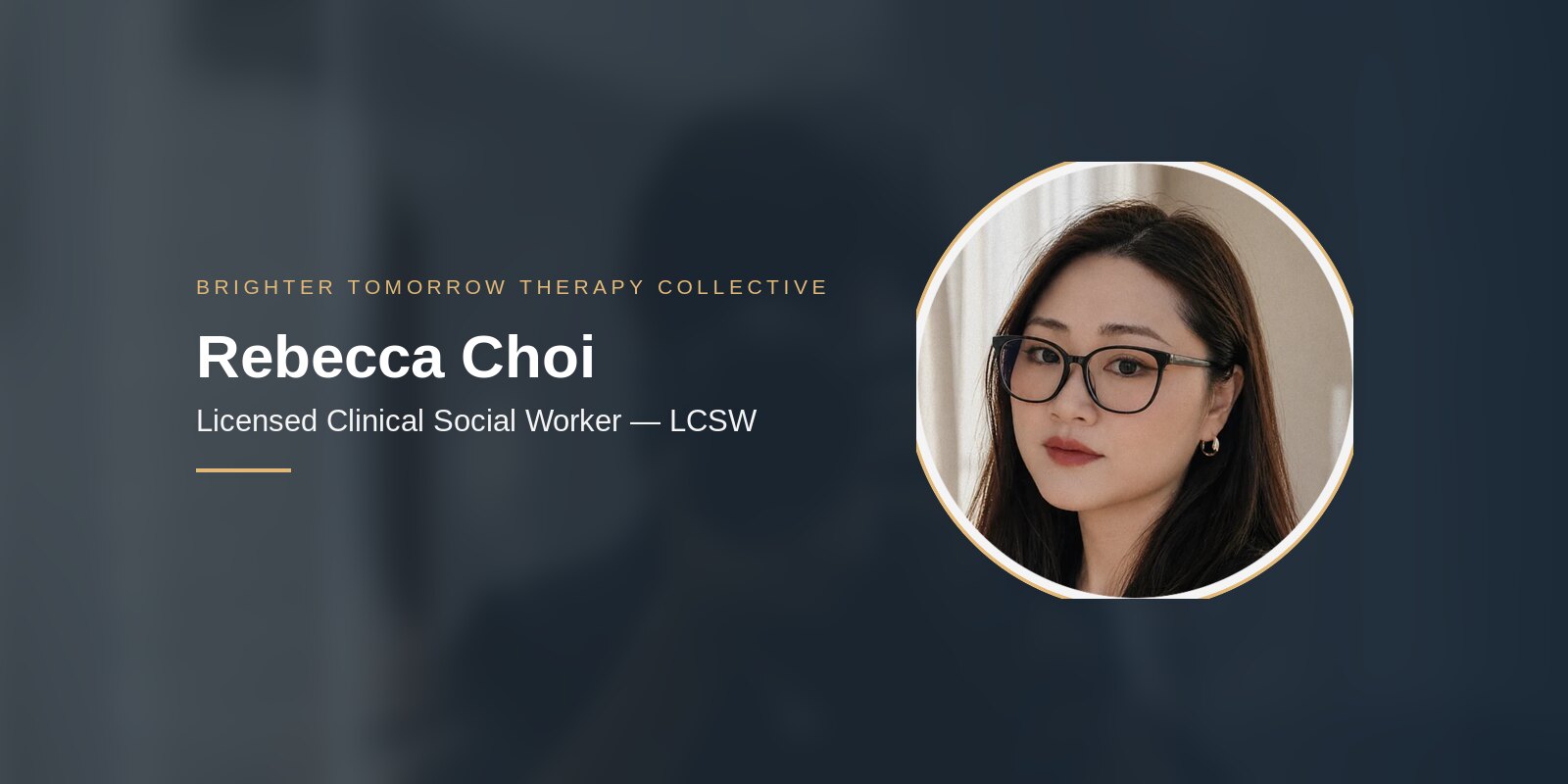
Written by Rebecca Choi, LCSW
Korean-language therapy in Las Vegas means the session itself is conducted in Korean — not through an interpreter, not with a family member translating in the room. I am a licensed clinical social worker who speaks Korean, and I see clients in Korean, in English, or in whatever mix a given hour calls for. Sessions are available at either of our valley offices or by secure video anywhere in Nevada.
The language you were hurt in is usually the language you have to talk in
People sometimes assume the reason for wanting Korean-language therapy is fluency. Usually it is not. Plenty of the people who ask me for it speak excellent English, run businesses in English, raise children who answer them in English.
The reason is that the things they most need to say happened in Korean.
A parent's sentence from 1987. What an aunt said at a funeral. The particular tone your mother used when she was disappointed, which does not survive translation, because what made it devastating was not the words. If you try to describe that in English, you end up producing a summary. The summary is accurate and it does nothing, because the feeling stayed behind in the original.
What changes when you stop translating
Translating while you talk takes attention. It takes it from exactly the place therapy needs it — the half-second where something surfaces and you decide whether to say it.
When people switch into Korean mid-session, a few things tend to happen at once. The pace slows. The voice drops. Sentences get shorter, and then stop, and then the real one arrives. I have watched people spend twenty minutes describing a childhood in careful English and then change languages and cry in the first sentence.
That is not because Korean is more emotional. It is because the memory is filed there.
The reverse also happens, and it is just as useful. Some people find it easier to say certain things in English — that they are angry at a parent, that they are considering divorce, that they do not want children. English creates a small distance, and sometimes distance is what makes a sentence possible for the first time. Being able to move between the two is the point. Nobody has to pick.
Who usually asks for Korean-language therapy
There is not one Korean-speaking population in Las Vegas, there are several, and they come in with different things.
First-generation adults who immigrated as adults, often carrying a decade or more of unnamed depression that was treated as tiredness. People who came for a job in hospitality or healthcare and found the valley harder to make friends in than they expected. Parents whose adult children are American in ways they did not anticipate and cannot discuss. Older adults who have been in this country forty years and have never once said any of it out loud.
And the 1.5 and second generation, who often book in English and then discover mid-session that they want to describe their family in Korean because the family only exists in Korean.
"My English is fine" is true and also not the point
I hear this a lot, usually as an apology for asking.
Your English being fine is not in dispute. What I would ask you to notice is whether you find yourself editing. Whether you choose the simpler word because the exact one would take a paragraph to set up. Whether you leave things out because explaining the context — who the person is, why that particular comment landed the way it did, what it means that your father did that at that moment — feels like too much work in a fifty-minute hour.
Editing is the cost, and most people paying it have stopped noticing.
The small-community problem
Las Vegas has a Korean-speaking community large enough to have real life in it and small enough that people know each other. That creates a specific hesitation: if I go to therapy, who finds out?
The answer is no one. Clinical records are confidential and protected by law. There are a few narrow exceptions, which any therapist should go over with you in full at the first session, and none of them involve your church, your employer, your family, or the person who referred you.
I say this early with Korean-speaking clients because the concern is rational. It is not paranoia to notice that the community is interconnected. It is just worth knowing that the interconnection stops at the door.
If it would still be easier not to be seen walking into a building, video sessions solve that entirely, and many people use them for exactly that reason. Teletherapy is available across Nevada.
What I actually work on
My clinical focus is anxiety, depression, OCD, trauma, and life transitions — immigration, divorce, a career ending, a parent's decline. The cultural piece is not a separate service. It is the context those problems live in.
Practically, that means I do not need the background explained. When a client says their mother called about a cousin's wedding, I already understand what is being asked of them and what refusing would cost. When someone says their father never said anything, I do not treat that as evidence of a cold family. We can skip the part where you teach me, and use the hour on your actual problem.
You can read more about my training and approach on my team page.
Common questions
Can I switch between Korean and English in the same session?
Yes, and most people do without planning to. There is no rule about it. Some clients start in English and move to Korean when the subject gets closer in; some do the opposite. I follow you.
Do you work with couples or families where one person speaks more English than the other?
Yes — the practice offers couples counseling and family therapy, and I take mixed-language cases. Mixed-language couples and parent–adult child pairs are common, and the language gap is often part of what the work is about. Sessions can run bilingually so neither person is stuck waiting to be translated for.
Is Korean-language therapy different from regular therapy?
The methods are the same evidence-based ones — cognitive behavioral work, exposure and response prevention for OCD, trauma-focused approaches. What differs is that less of the hour goes to explaining context, and more of it goes to the thing you came for.
Where are your offices?
We have two locations in the valley: one on E Russell Road in the east valley and one on N Durango Drive in the northwest. Either works, and video is available if neither is convenient.
If you have been putting this off
Most people who reach out have been thinking about it for a long time — often years. That is normal and it is not a failure of will. Starting is a single conversation, in whichever language makes it easier to start.
You can reach out here and say as much or as little as you want about why.