

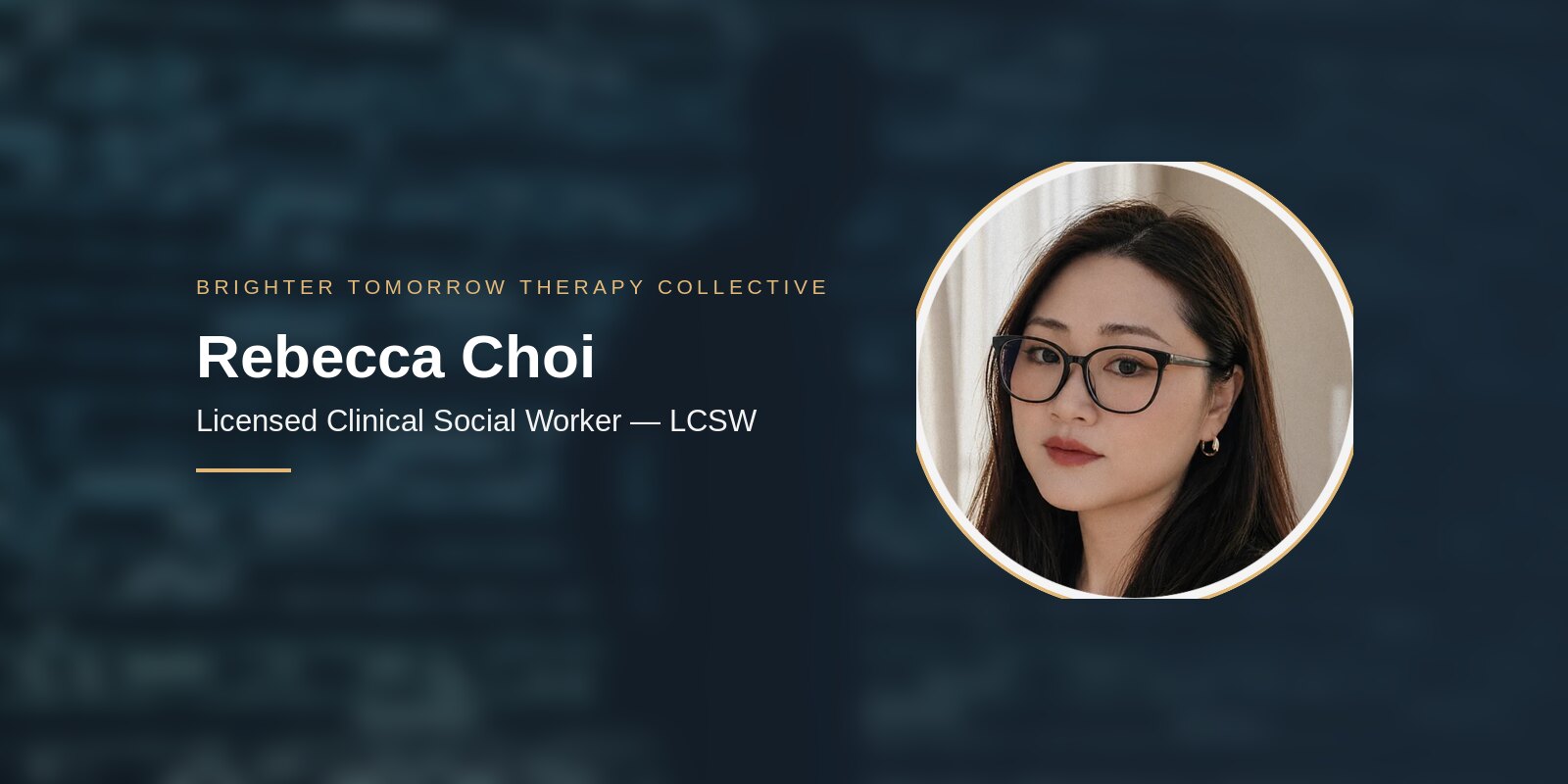
Written by Rebecca Choi, LCSW
The 1.5 generation refers to people who immigrated as children — old enough to remember the first country, young enough to be formed by the second. They are not first generation, because they grew up here. They are not second generation, because they did not start here. In therapy, the 1.5 generation tends to arrive with a particular set of problems: an unclear sense of belonging, a lifelong role as the family's interpreter, and a quiet conviction that they are doing both cultures slightly wrong.
Who counts as the 1.5 generation
There is no official age cutoff, and the boundaries are fuzzy on purpose. Roughly, it covers people who arrived somewhere between early childhood and the late teens.
Arriving at six is a different experience than arriving at fifteen. The six-year-old loses the first language faster and picks up unaccented English; the fifteen-year-old keeps fluency and arrives in the middle of adolescence, which is a brutal time to be new. Both end up in the same odd position: the family's hinge, fluent in the home and fluent outside it, fully native to neither.
If you have ever been unsure which box to check on a form about your background, and found that the honest answer required a paragraph, you are probably in this group.
Neither language is entirely home
Most 1.5 generation adults have an uneven map. There are domains where only English works — your job, your medical vocabulary, jokes, anger. And domains where only Korean works — food, family, the exact word for what an aunt did at a wedding, the register you use with someone older.
So you speak one language well and one language warmly, and neither one covers the whole of you.
This shows up in therapy immediately. Someone can describe their depression in fluent clinical English and then stall completely when asked about their mother, because the material is filed in a language the session is not being held in. Being able to switch mid-sentence, without apologizing for it, removes a barrier most people did not know was there.
It also shows up as a specific grief in people whose Korean faded. Losing a first language is a real loss, and it frequently comes with shame — being unable to talk properly with a grandparent, being praised by strangers for speaking English so well, being teased in either direction. That is worth talking about rather than treating as a logistical fact.
The translator never got to retire
Many 1.5 generation kids were the family's interface with America from about age nine. Doctor's appointments. Lease agreements. Parent-teacher conferences where they translated their own report card. Phone calls to the insurance company during recess.
The skills that produced are genuine: composure, adult-level reading of a room, an ability to manage situations well above one's pay grade.
The cost is also genuine. A child in that role learns that the family's functioning depends on them, that their own needs are the least urgent item in the house, and that competence is what makes them valuable. Twenty years later, that shows up as an adult who cannot delegate, cannot rest without justification, and feels a flash of guilt when a parent calls and they do not pick up immediately.
The role often never formally ends. People in their thirties and forties are still handling their parents' paperwork, appointments, and increasingly their medical decisions — which is reasonable and also worth examining for how much of a life it takes.
"Too American for them, too Korean for here"
This sentence, in some phrasing, comes up in nearly every 1.5 generation intake I do.
At home you are the one who has become too direct, too individualistic, too unwilling to defer. Outside, you are read as reserved, hard to get to know, deferential in ways that get mistaken for a lack of opinion. The feedback is contradictory and constant, and the natural conclusion is that the flaw is in you.
It is worth saying plainly that being between two cultures is not an identity failure. The discomfort is real, but it is located in the gap, not in the person standing in it. Many people find that the goal is not to resolve into one side — it is to stop treating the in-between position as a problem to be solved and start treating it as where they live.
That sounds like a small reframe. In practice it ends a decades-long internal argument, which is not small at all.
What the work usually involves
Three threads come up most often.
Separating your own standards from inherited ones. A lot of 1.5 generation adults are running a scoreboard they never chose — a career their parents would recognize as respectable, a marriage timeline, an achievement level set by what the immigration was supposed to be worth. Untangling which values are actually yours takes time and produces real relief.
Renegotiating the family role. Not abandoning it — that is rarely the goal or the outcome. Deciding what you carry, what you hand back, and what you can stop apologizing for.
And treating the actual condition, if there is one. Anxiety, depression, and OCD do not become cultural questions just because the person has a complicated background. The context matters, but the treatment is the treatment, and it works.
If you are starting from scratch, individual therapy is the usual entry point, and the first session is mostly you describing the situation to someone who does not need the background explained.
The part that is not a wound
It would be inaccurate to write about this as pure difficulty.
People who grew up across two systems generally read situations faster, hold two contradictory framings at once without distress, and adapt to new environments with unusual ease. Those are genuine capacities, built by exactly the circumstances that were hard.
The work is not to fix the in-between. It is to stop paying for it with constant self-monitoring.
Common questions
Do I need to speak Korean to work with you?
No. Many 1.5 generation clients work almost entirely in English and use Korean only for the phrases that will not translate. Use whatever comes out.
My parents and I fight about completely different things now. Is that a culture problem?
Often it is a mix — a genuine values difference plus an ordinary adult-child conflict that would exist in any family. Separating the two is useful, because they need different approaches, and treating everything as cultural makes it feel unfixable.
I feel guilty for wanting distance from my family. Is that normal?
Extremely. Wanting room and feeling obligated are not contradictory, and most people in this position hold both permanently. The work is usually about finding an arrangement you can live with rather than choosing a side.
Can therapy help if the real issue is my parents, and they will never come in?
Yes. Most of this work happens with the person in the room. Your relationship to what you inherited can change substantially without anyone else participating.
If any of this sounds familiar
The 1.5 generation rarely arrives in therapy over identity as such. People come in because of anxiety, a decision they cannot make, exhaustion, or a fight with a parent that will not resolve — and the between-ness turns out to be underneath it.
You can see more about my training and how I work on my team page. When you want to talk, send us a message and say whatever is easiest to say first.