

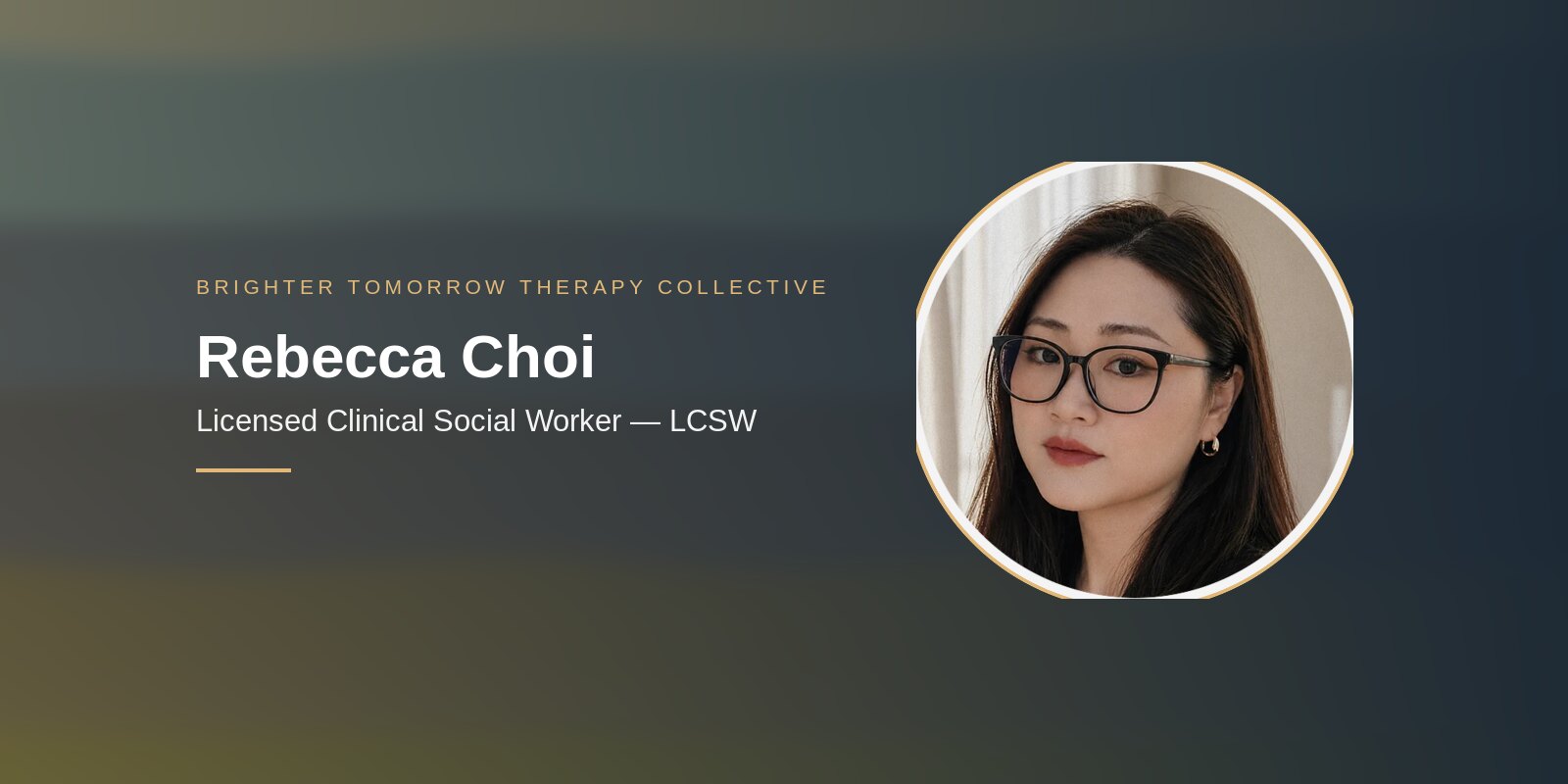
Written by Rebecca Choi, LCSW
"If I go to therapy, it means my family failed." That sentence, or some version of it, is the most common thing I hear from Korean Americans who have been putting off making an appointment. Therapy for Korean Americans usually has to address that belief first, because until it is addressed, everything else is theoretical.
The belief is not irrational. It comes from a real structure in which a person's difficulty is never only their own.
What does "face" mean in a Korean family?
In English, "saving face" sounds like vanity — protecting your image. 체면 (chemyeon) is not that. It is closer to the standing your family holds in the eyes of the people whose opinion forms the world you live in.
The difference matters because of who owns it. Your image belongs to you. Chemyeon is shared. Your job, your marriage, your child's college, your divorce, and your depression are not individually held facts; they are entries in a family ledger that other people read.
That is why disclosure feels dangerous in a way that does not translate. You are not worried about being embarrassed. You are worried about spending something that belongs to your parents.
Why does getting help feel like an accusation?
Because in a family ledger, a problem implies a cause, and the cause is usually assumed to be upbringing.
So when an adult child says they are anxious, a parent frequently hears: you did something wrong to me. And the adult child, knowing that is how it will be heard, stops talking. Both people are protecting the other, and the result is a family in which no one can say anything true.
This is the point where I usually say something that surprises people: therapy does not require your parents to be at fault, and good therapy is not a prosecution. It is entirely possible to say "my mother did the best she could with what she had, and I am still depressed" and have both halves be literally true. Those are not competing claims. The insistence that they must be is the thing causing damage.
Is it shame or is it guilt?
Worth separating, because they respond to different things.
Guilt is I did something bad. It points at an action and can be addressed by repair. Shame is I am bad, and it points at the self, where there is nothing to repair, so it produces hiding instead.
A lot of what Korean American clients bring in is shame wearing the clothes of guilt. Not being enough. Being the disappointing one. Having the wrong career, the wrong partner, the wrong amount of money, the wrong feelings. And because shame produces hiding, the response is to work harder and say less, which raises the pressure and confirms the belief.
Shame does not respond well to argument. You cannot reason someone out of it, and you certainly cannot do it alone in your own head. What reduces it reliably is saying the thing out loud to a person who does not react the way you predicted. That is not a metaphor for therapy; it is a fairly literal description of the mechanism.
Is 눈치 a skill or a symptom?
눈치 (nunchi) is the ability to read a room — to know what someone needs before they ask, to sense the temperature of a situation instantly. It is genuinely valuable. It makes people good managers, good clinicians, good hosts.
It is also, in some families, a skill built under pressure, by a child who had to monitor an adult's mood to stay safe or to prevent a scene. When that is the origin, the adult version looks less like social grace and more like scanning that never stops.
The useful question is not whether to have nunchi. It is whether you can turn it off. If you cannot sit in a room without tracking everyone's state, if you know what everyone at the table is feeling and cannot say what you are feeling, that is worth looking at. Anxiety treatment with Korean American clients is often partly this: keeping the skill, dropping the vigilance.
What happens if my family finds out?
Nothing leaves the room. Clinical records are confidential and legally protected; there are a few narrow exceptions, which a therapist will explain in full at the start. Your family is not entitled to information about your care, and neither is anyone else.
In a valley where the Korean-speaking community is interconnected enough that people recognize each other, that concern is reasonable and I do not treat it as excessive. It is also solvable. Some clients prefer video sessions for exactly this reason, and some prefer the office that is farther from where they live. Either is fine, and neither requires explanation.
Does the work mean cutting my family off?
Almost never, and I want to be direct about that because the internet has a loud opinion here.
The standard English-language advice is to set boundaries, reduce contact, protect yourself. Sometimes that is correct. But it assumes a family you can step away from without stepping out of your own life, and for many Korean American adults that is not the situation. Obligation runs in both directions, other relatives are implicated, and a clean exit does not exist.
So the work is usually more specific than distance. What exactly is costing you — the visits, or a particular subject that comes up during them? What do you actually control? What changes if you stop trying to get a sentence out of a parent who has never said that sentence to anyone? Frequently the outcome is a relationship that continues with less of you being injured inside it, which is unglamorous and works.
When a family is willing to come in together, family therapy can do this directly, including across a language gap. When they are not — which is common — the work happens with you, and it still changes the relationship.
Common questions
My parents will say therapy is for crazy people. How do I answer that?
You often do not have to answer it, because you do not owe anyone the information. If you choose to tell them, describing it in functional terms — sleep, stress, work pressure — tends to land better than clinical language. That is a strategy, not dishonesty.
Can I do this work in English if my Korean is weak?
Yes. Many second- and 1.5-generation clients work primarily in English and drop into Korean only for the phrases that will not translate. The point is that you never have to explain the background from scratch.
Is it disloyal to talk about my parents to a stranger?
This comes up constantly. Describing your history accurately is not an attack on the people in it, and the goal is not a verdict on them. Most clients find the work makes them more able to be in the relationship, not less.
What if I do not know what I feel?
That is a normal starting point, especially for people raised to attend to everyone else's state first. Not knowing is workable material, not a barrier to beginning.
Starting
If you have read this far, you have probably been considering it for a while. You can learn more about my background on my team page, or simply book a first session and decide the rest later. Nothing has to be explained in advance.